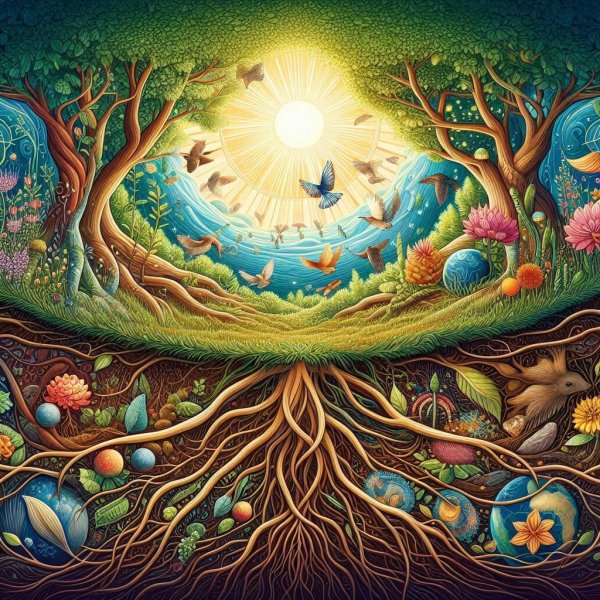
Our physical and mental health and well-being are intimately linked to how we relate to ourselves, others, and the world around us. Although we have distinct and separate bodies and private subjective experiences, we are interconnected. The well-known saying, “No man is an island,” was written by the metaphysical poet John Donne when suffering from typhus in 1623. He wrote, “No man is an island, entire of itself; every man is a piece of the continent, a part of the main”. We now know that everything in our Solar system is interconnected at some level, not just “man”.
In the science of complex adaptive systems, it’s not the objects themselves, but the inter-relationships and interactions between them that make a difference. Examples of complex adaptive systems include the human body, the Earth’s natural environment, and organisations. Our body is something we take for granted every day. Outside of our general awareness, something like eleven interdependent systems work together to keep us healthy and alive. For example, our muscles need oxygen, which is provided by our lungs and circulatory systems, which are dependent on the muscle system to work. In addition to oxygen, our bodies need food and water for energy and to replenish cells. Almost all of this comes from the natural world around us, which we are also part of.
So, what does relating have to do with mindfulness? With consistent daily practice, mindfulness changes the relationship we have with our experience. It transforms the way we perceive our bodies, emotions, thoughts, and what we experience through our senses. It also changes how we relate to ourselves and other people. These changes come from awareness and insight, as well as how we respond to our present-moment experience. People who practice mindfulness tend to be less reactive and experience greater emotional stability and mental clarity. They also bring a greater appreciation of others and the world around them and are more open, patient, kind, and understanding.
Rather than being fully absorbed and identified with our thoughts, we can see them as mental content with energy and purpose that comes and goes. So, although many thoughts may be about our experience, we know that our thoughts are not who we are. Similarly, rather than being fully absorbed and taken over by emotions that come and go, we can feel that something needs attention, acknowledge the emotion, and use the energy and impetus to act. Like thoughts, although emotions relate to our experiences, we know that we are not our emotions.
As social animals, how we understand, communicate, and relate with others makes a big difference to our happiness and well-being. Research shows that the quality of our close relationships contributes to our general life satisfaction, self-worth, and resilience. We all want to be heard, understood, valued, and accepted for who we are, which we intuitively know is always a two-way, symbiotic relationship.
Mindfulness is about becoming aware of and investigating the habitual attachments and assumptions we hold about who we are, other people, and the world around us. Our brain evolved to operate on shortcuts, which makes good evolutionary sense. Why process the same thing with the same level of concentration when it appears every day? The downside is that our perception can become dull, and we end up being less aware of habitual thoughts, feelings, and behaviours. The practice of mindfulness gives us the skills to understand and break free from limitations and appreciate how we relate to ourselves, others, and the world around us in all its rich complexity, beauty, and wonder.
Suggested weekly practice
- Contemplate the relationships between things. These could include your body, emotions, thoughts, speech, sounds, nature, food, time, seasons, the weather… The list is endless.
- Use curiosity and beginner’s mind to explore unnoticed, fixed habits and assumptions about yourself, other people, and the world around you.
- Pick a familiar daily object that you own and explore your relationship with it. How long has the object been with you? When was the last time you really looked at it with openness and curiosity to appreciate the materials it’s made of, noticing signs of wear, or whether the object is part of an embedded habit?
Guidance
Find somewhere undisturbed and sit in a comfortable, dignified, and upright posture, where you can remain alert and aware.
There are two guided practices for this session. You can close your eyes, or lower your gaze while the meditations play.
- Play the settling practice, then read through the session content, which you can print off if that helps.
- Then play the second audio to explore how we relate to our body, emotions, and thoughts.