We have never had access to so much information, including twenty-four-hour news, which we can consume on a variety of devices. With so many terrible things going on in the world, it’s no surprise that people are steering clear of the news. Recent surveys show that “news avoidance” has grown in recent years, with over a third of the population choosing to disengage from daily updates on politics and world events.
In addition to information overload, people turn away from the news because it lowers their mood, makes them feel powerless in the face of global issues, and fuels growing distrust of news sources. There is also another reason: that we yearn for a simpler, slower, and more peaceful life, where we reconnect with and appreciate what it means to be human with a sense of wonder.
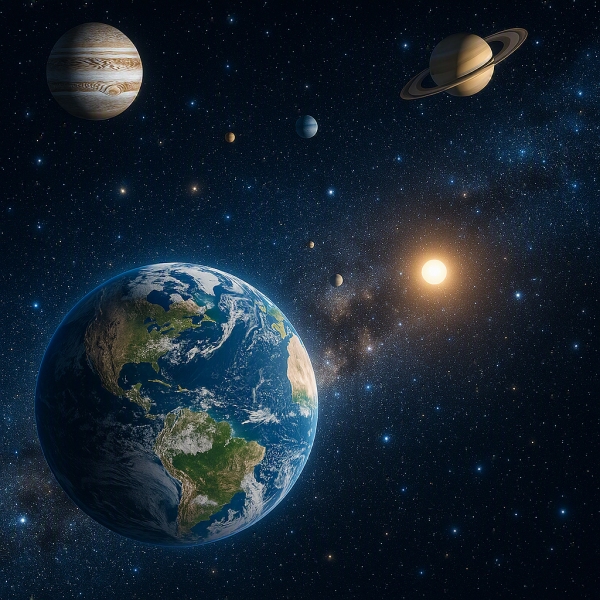
There is the Earth, the four-and-a-half-billion-year-old planet we live on, and the collective consensus of society, culture, language, identity, politics, money, and so on: the “World” humans have created, hovering over the natural planet.
When we grow up and become adults, we end up seeing the “World” as the primary reality and the Earth as secondary. It’s this mistake that led to the climate crisis and some of the other challenges we face.
The German Philosopher, Arthur Schopenhauer said that “Behind our existence lies something else that becomes accessible to us only by our shaking off the world”. He was pointing to the need to move beyond the surface of our worldly existence to discover a deeper, more meaningful truth. And one way to discover this meaning is to experience wonder.
Wonder is a complex cognitive and emotional state which involves a sense of awe, curiosity, and amazement in response to something extraordinary, beautiful, or mysterious. Wonder can include a range of emotions, such as joy, peace, and happiness, like when watching a beautiful sunset. We can also experience wonder when we use curiosity to expand our understanding. Of course, many human achievements can also make us feel a sense of wonder. For instance, the discovery of DNA, artificial intelligence, images from the James Webb telescope, as well as art and culture. But almost all of these build on what is already there in the universe.
Examples of things that we take for granted when we are caught up in the world include:
- The beauty and complexity of the world around us, including our own body, which has over thirty trillion cells and eleven interdependent systems that keep us healthy and alive.
- Although we may have some limits on our attention and ability to process more than one thing at a time, our human mind has the potential to store and process unlimited thoughts, knowledge, ideas, and memories, with possibly boundless creativity and imagination.
- The nature of life and how it is created, from a newborn baby through to the different stages of life.
- The reality of living on this massive rotating planet, formed over four and a half billion years ago in our solar system, one of over three thousand in our local galaxy, in a universe of two trillion other galaxies.
- The uniqueness of each moment, each breath, every face, every particle of sand on a beach, and every cloud in the sky.
Wonder and mindfulness are linked in several ways. Both can enhance our overall well-being and our appreciation of ourselves, others, and the world around us. By being more aware of and engaged, we are more likely to notice and appreciate the rich complexity of the present moment, which expands our sense of wonder. By bringing curiosity and openness to our experience, we can see the world through fresh eyes and experience the wonder and uniqueness of each moment. With heightened awareness, we can start to appreciate the extraordinary aspects of life with a sense of wonder at the beauty and mystery of the world around us. Mindfulness helps us reduce stress and find emotional stability, creating space to experience wonder. When we practice mindfulness, we often rest our attention on the natural world. Maybe walking quietly through the woods, appreciating the peace, stillness, and sounds of nature, and experiencing a sense of wonder and connection.
Suggested weekly practice
- Explore the difference between the World that we have made and the natural Earth beneath our feet.
- See if you can experience a moment of wonder every day.
- Notice what you take for granted and use curiosity and openness to appreciate the often hidden richness, uniqueness, and complexity of life.
Guided practice
Find somewhere undisturbed, sit in a comfortable, dignified, and upright posture, where you can remain alert and aware.
You can close your eyes, or lower your gaze while the meditations play.
- Play the first settling practice, then either read through the session content or play the talk on stability and balance below.
- Then play the second practice to reconnect with and experience a sense of wonder.